How Explorers Planned When Turning Back Was Fatal
Shackleton turned back 97 miles from the Pole because the food would get his party there but not home, however much he wanted to reach it.

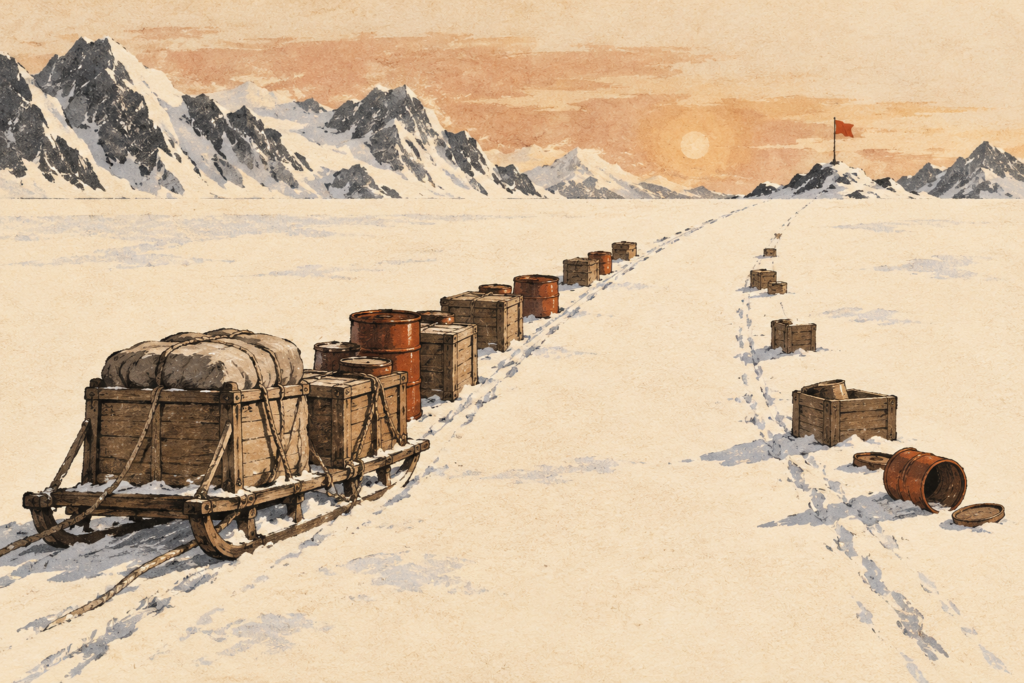
On 9 January 1909, Ernest Shackleton and three companions stood at 88°23’ south, 97 miles from the South Pole and closer to it than anyone had ever been. They had enough food to reach it. What they did not have was enough food to reach it and then walk home again, and on that day the gap between those two sums was the only thing worth looking at.
He turned the party around. It is generally regarded as one of the better decisions in the history of polar exploration, and the reasoning behind it is a clear example of a question most people rarely ask about their own commitments: if I carry on, will I still be able to get back?
Why wanting the Pole had no bearing on the decision
Wanting the Pole had no bearing on the decision, because the limit was set by the food supply and no amount of desire could add to it. Everything else about the situation pushed towards continuing: years of preparation, enormous expense, the nearest approach anyone had made, and a prize that somebody else would claim within three years.
None of that could enter the calculation in a useful way. The party could go forward or come home, and it could not do both. Once that was established, the strength of Shackleton’s ambition told him nothing about whether the Pole was reachable on the supplies he had left.
Polar travel enforces this discipline because it makes irreversibility visible. Every mile walked forward is a mile that has to be walked back, on rations that are strictly finite, so the arithmetic is there on the sledge for everyone to see. Under those conditions the investment already made has nowhere to hide, and it cannot pass itself off as a reason to keep going.
How the ice stripped out the sunk cost argument
The ice removed the sunk cost argument by making the remaining distance the only figure that counted, whatever had already been spent to get there. In ordinary decisions, past investment slips into the reasoning far more easily. Hal Arkes and Catherine Blumer, in their research on the sunk cost effect, found that people are more inclined to continue an endeavour once they have put money, effort or time into it.
Shackleton had years and a great deal of money behind the attempt. What he lacked was any way of treating that as relevant, because the food supply was indifferent to it. In a project with no physical limit, the equivalent argument, that you have come too far to stop now, is available at every point along the way, and it usually gets made.
The lesson that carries over is to create the limit on purpose. Before you begin, write down the condition under which you will stop. A stopping point chosen before any investment exists is chosen by someone with nothing yet to defend, which makes it the practical counter to escalation when the project later starts asking for more.
Why expeditions sorted decisions by what could be undone
Expeditions sorted decisions by whether they could be undone, because on the ice an irreversible mistake could not be put right later. Most prioritisation frameworks sort work by importance and urgency. Polar planning sorted it by reversibility first.
Jeff Bezos made a similar distinction in his 2015 letter to Amazon shareholders, separating one-way doors, the irreversible decisions that deserve slow deliberation, from two-way doors, where being wrong mostly means walking back through. An expedition is a long run of one-way doors. The depot you have passed is behind you, the season closes on its own schedule, and the ice does not wait for anyone to reconsider. So the planning was dominated by margins and turning points, and the hardest decisions were about when to stop.
Applied to ordinary work, this changes the first question you ask of a choice. Before asking which option is most important, ask which one closes something, such as a window, a relationship, or an opportunity that will not come round again. That question separates close calls more reliably than importance does, and it is how two good options actually get decided between.
Why the turning point has to be set in advance
The turning point has to be set in advance because the person deciding at the furthest point is the one least able to decide honestly. That timing is the structural feature most worth borrowing from the way these journeys were planned.
A turning point worked out at 88°23’ by exhausted men who had just come further than anyone in history would hardly have been worked out honestly. The value of setting it beforehand is that the person setting it is not the person who will later want to overrule it.
The same imbalance runs through everyday decisions at much lower stakes. The evening version of you, with the day’s evidence in hand and nothing pressing, tends to decide better than the morning version already under pressure, which is the whole case for writing tomorrow’s line the night before.
Why polar plans built in a margin for things going wrong
Polar plans built in a margin because things reliably took longer and went worse than the planners expected, and the margin was there to absorb the difference. This cuts against a common instinct, which reads slack in a plan as a lack of confidence.
Assuming delays has little to do with temperament. It corrects for a well-documented tendency to be optimistic about one’s own estimates, and expeditions that left the margin out tended to discover their error at the point where it could no longer be fixed.
The everyday version is that a plan with no slack fails on its first ordinary bad day. Building in a margin can look like low ambition, but it is simply an accurate account of how projects run when nothing deliberately corrects for our optimism.
What turning back cost Shackleton
Turning back cost Shackleton the Pole itself, and the story is worth telling without tidying that away. Amundsen reached it in December 1911, and because of the decision at 88°23’, somebody else’s name is attached to it permanently.
That is the real shape of the trade. Turning back was correct, it cost him the thing he had spent years pursuing, and no framing makes that painless. What it bought was four men alive, which was the only outcome that left any future attempt possible at all.
Most working decisions are far less dramatic and share the same structure. The option that keeps you able to continue usually beats the one that reaches slightly further and cannot be sustained. That is the case for a small daily practice over a heroic fortnight, and for stopping a commitment deliberately instead of continuing because of what it has already cost.
The Do One Thing diary holds one printed line a day, and nothing rolls over from one day to the next. It has no way of recording how far you have already come, which is deliberate. Each page asks only what is worth doing today, the same question the food supply was asking on the plateau.
Shackleton reportedly wrote to his wife that she would rather have a live donkey than a dead lion. Whatever the exact wording, the arithmetic behind it was never in dispute, and when turning back was fatal, it was the only calculation that counted.