Creative Work on the Days the Ideas Don’t Come
Most sessions produce ordinary material. Treating that as failure is what turns a flat Tuesday into a fortnight of not sitting down at all.

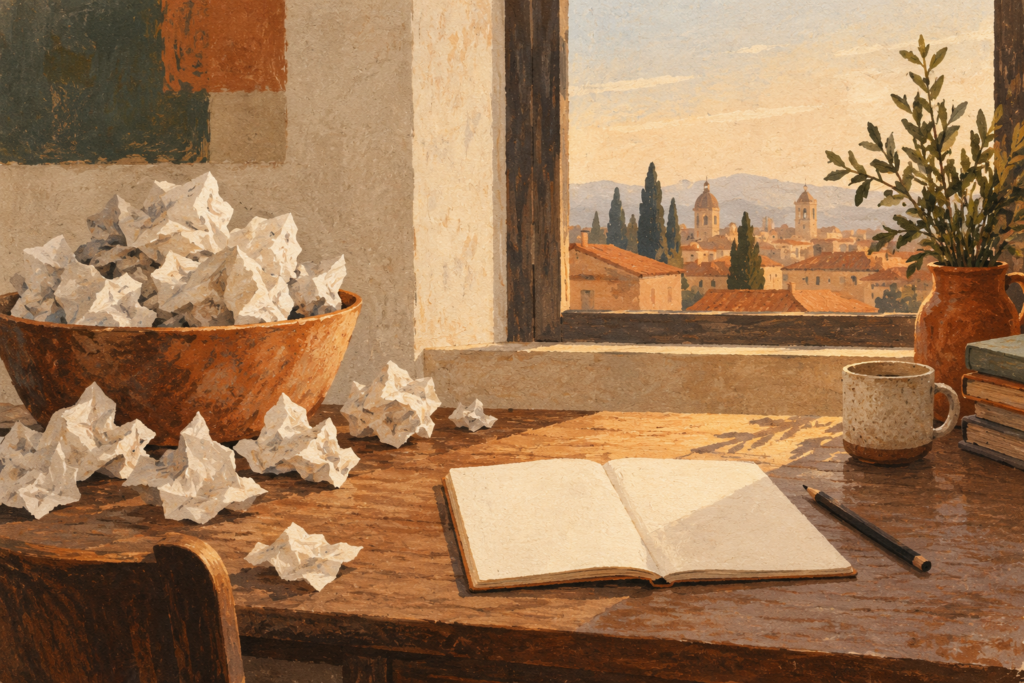
You cleared the morning, sat down with coffee, and gave the work a full ninety minutes. What came out is flat. It isn’t wrong, exactly; it is just ordinary, the obvious version of the idea, the one anyone could have written. You close the file feeling that the morning was wasted, and by lunchtime you have half decided that the well has run dry.
That conclusion does far more harm than the session itself. One flat Tuesday costs a morning, but the belief that it proves something about you is what turns it into a fortnight of not sitting down at all.
Why most creative sessions produce ordinary material
Most creative sessions produce ordinary material because that is simply how creative work is distributed. The expectation doing the damage is that a good session should yield good material, and nobody who does this kind of work gets that reliably.
The usual pattern runs something like this. Most sessions produce serviceable work that will be heavily rewritten later. A smaller number produce something that survives more or less intact. Once in a while something arrives that is better than you can normally manage. The flat sessions make up the bulk of that pattern, so a day that produces one is an ordinary day.
So judging a day by whether the output was good means judging it by an outcome you do not control, over a stretch so short that it is mostly noise. On days the ideas don’t come, the more honest test is whether the session took place.
What the research on time pressure says about flat days
The research suggests that flat days often come from a fragmented day rather than from a lack of talent or mood, which matters because people tend to blame themselves first.
In a study published as Creativity Under the Gun, Teresa Amabile, Constance Hadley and Steven Kramer worked through more than 9,000 daily diary entries from 177 employees doing creative project work. Many employers assume that people think most creatively under time pressure, and the diaries mostly pointed the other way.
The part most useful on a flat day is the distinction they drew within the pressured days. Where pressure came with no creative thinking, people described feeling as though they were on a treadmill, pulled between tasks and switching gears constantly. Where pressured days still produced creative thinking, people described being on a mission, protected from distraction and working on one thing.
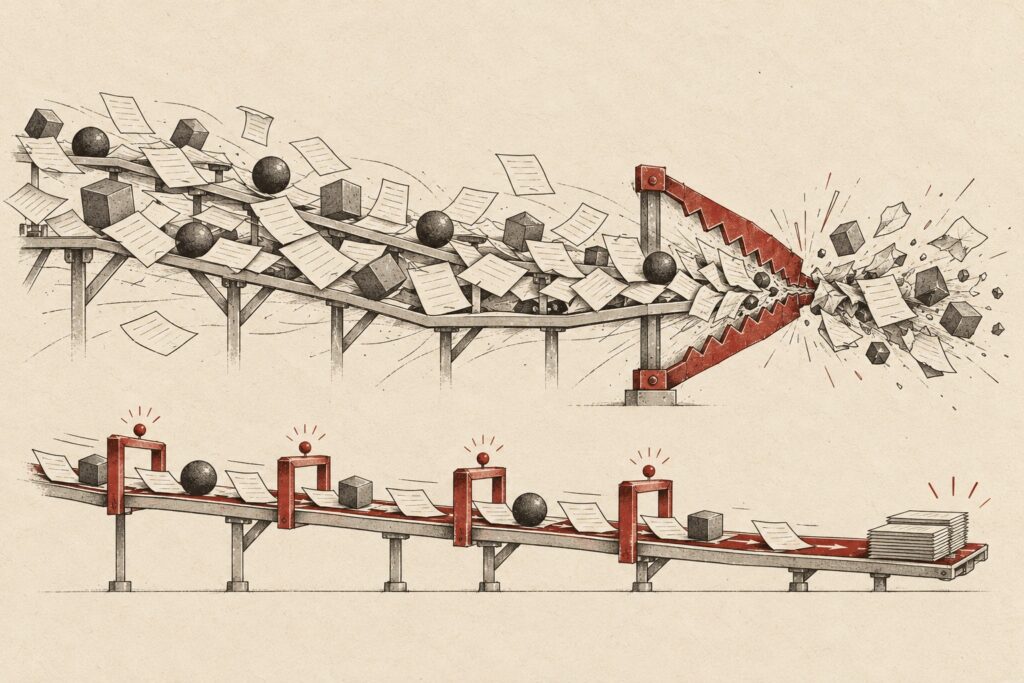
That gives you something specific to check before you blame yourself. Look at how the morning was actually spent. A session broken by six interruptions will produce ordinary work however much you care about the project, and in that case the mood is taking the blame for a problem with how the day was arranged.
Why lowering the bar works better than trying harder
Lowering the bar for what counts as a finished session works better than trying harder, because trying harder raises the stakes on an activity that will usually produce ordinary results. The instinct after a flat morning is to promise yourself a longer, more focused, more committed session tomorrow, and that promise makes tomorrow heavier to begin.
The more useful move is to define a session by a quantity or a named piece of work. Three hundred words counts, and so does one sketch, or the next section drafted badly. A definition like that can be met on a bad day, which a target such as “produce something good” cannot.
Amabile and Kramer’s later diary work found that making progress on meaningful work was the event most associated with good working days, and that even small steps forward counted. The part that helps on a flat morning is narrow: a session defined as three hundred words gives you a step you can see you have taken. “Did good work today” gives you nothing to see, because on most days you cannot honestly answer it.
The flat material earns its keep too. It is what the next session revises, and a page of ordinary prose is a much better place to start from than an empty one.
When a walk helps a stuck session and when it doesn’t
A walk helps when the session is stuck for lack of options, and does much less when you already have options and cannot choose between them.
Marily Oppezzo and Daniel Schwartz found that walking improved performance on a divergent thinking measure, which asks for many possible answers, for 81 per cent of participants, with the effect lasting a short while after the walk. On a convergent task with a single correct answer, only 23 per cent improved.
That difference tells you when to reach for it. If you have no angle and nothing to try, a walk is likely to do more than another hour at the desk. If the problem is deciding between three decent openings, the walk will be pleasant and probably will not settle it. Take the question with you and leave the phone at home, or the walk stops doing that particular job; there is more on why walking changes the kind of thinking you can do.
Why stopping mid-sentence makes tomorrow easier to start
Stopping mid-sentence makes tomorrow easier because it leaves you an obvious way back in. Finishing at a clean break feels satisfying, but it hands the next session a blank page and the hardest kind of start.
Stopping partway through a thought, with the next move plain, turns tomorrow into a continuation. Picking up a sentence is a far smaller act than beginning a new one, especially for someone arriving at the desk without much enthusiasm.
This matters most after a flat session, because the real cost of a flat session is that it makes the following morning harder to face. A visibly half-finished paragraph removes most of that resistance before you have even sat down.
How to judge creative work across a fortnight rather than a day
Judge creative work over a fortnight, because a single session tells you almost nothing about whether the work is going well. Any one session reflects how you slept, how often you were interrupted, which part of the project you happened to reach, and a fair amount of luck. Reading a flat Tuesday as a verdict on your ability means drawing a conclusion from a sample of one.
Ten written lines across a fortnight tell you something real: how many sessions happened and what each one produced. That record usually shows more progress than your impression of the fortnight does, because flat sessions stick in the memory and ordinary productive ones fade, which is what a small honest record actually corrects.
Write down whether the session happened and what came out of it, and leave out any rating. A score out of ten brings back exactly the quality judgement that made the flat morning feel like failure in the first place.
If the flatness lasts for weeks, spreads to everything rather than just the work, and does not lift once you are underway, it looks more like depletion than a creative dry spell. That is worth raising with a doctor rather than trying to fix with a better routine.
We built the Do One Thing diary to hold one printed line a day, decided the night before, with nothing to score. For creative work that pairing does what is needed: the line names a piece you can complete rather than a standard of quality, and it records that the session happened on a day you might otherwise remember only as a bad one.
The ideas were never going to arrive on schedule. The session can, and over a fortnight it turns out to be the part that mattered.