The Reason You Can’t Focus Anymore Isn’t Willpower. It’s Boredom Avoidance.
There is a particular moment that decides whether you will do good work today. It arrives a few minutes into a hard task, just as the easy part runs out and the…


It is twenty to ten, the coffee is still hot, and you are a few minutes into the hard task you promised yourself you would start. The easy opening part has run out, and the real thinking is about to begin. The sentence will not come, or the spreadsheet refuses to balance, and a small, almost physical restlessness rises in you. Before you have quite decided anything, your hand is drifting towards your phone.
Most of us read that moment as a lapse of willpower. It makes more sense as a lapse of tolerance. What you are feeling is boredom, and the reflex to escape it is the most reliable way to make sure you never build the capacity for sustained focus. Boredom is part of the route to concentration, the cost of getting there, and learning to pay it is most of the skill.
How unpredictable rewards train you to reach for your phone
Unpredictable rewards train you to reach for your phone because the brain responds more strongly to a reward it cannot forecast than to one it can. Dopamine, often described loosely as a pleasure chemical, is closer to a signal about expected reward. The neuroscientist Wolfram Schultz showed in his work on dopamine neurons that these cells respond most strongly to rewards that arrive unexpectedly, the ones you could not quite predict.
Unpredictability is what makes certain stimuli so hard to leave alone. The psychologist B. F. Skinner found decades ago that animals responded far more persistently when the payoff came unpredictably than when it arrived on a fixed schedule, a pattern he called a variable-ratio schedule. Intermittent, unpredictable reinforcement is among the most stubborn behavioural hooks known, and it is no coincidence that it matches the logic of the pull-to-refresh feed, the notification badge and the endless scroll. As Adam Alter documents in Irresistible, many of these products are built around the same variable-reward loop that makes a slot machine hard to walk away from.
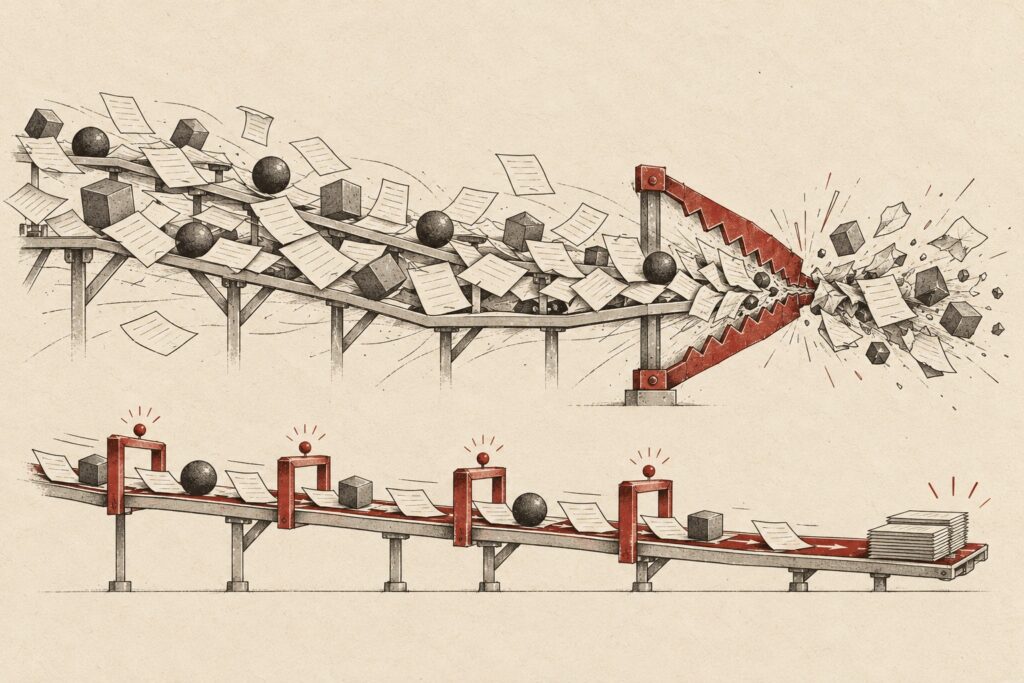
The larger cost of all this is the expectation it trains, more than the minutes it takes. Each time you reach for something new as your attention dips, whether it is a glance at email, a new tab or a refreshed feed, you repeat a single lesson: as soon as work becomes effortful, relief is one tap away. Over thousands of repetitions the brain learns that lesson well. It comes to treat boredom as an emergency to be solved, when it could have been a sensation to sit with.
Why constant relief from boredom works against deep work
Constant relief from boredom weakens your ability to concentrate, because concentration is a skill that has to be practised and every escape is practice in the opposite direction.
Cal Newport, the Georgetown computer scientist who wrote Deep Work, says this directly. Among his core principles, alongside the expected advice about protecting time, is a plainer instruction: embrace boredom. He argues that the ability to concentrate has to be trained, and that relieving every moment of boredom actively untrains it. “If every moment of potential boredom in your life,” he writes, “is relieved with a quick glance at your smartphone, then your brain has likely been rewired to a point where […] it’s not ready for deep work.”
The most useful part of Newport’s argument is that the damage happens away from the desk. Most people picture focus as something summoned when they sit down to work. If you spend the queue at the coffee shop, the walk to the station and the advert break reaching for stimulation, though, you are practising distraction in each of those moments. It is unrealistic to expect that habit to switch off the instant a hard task needs your attention, when you have spent the rest of the day strengthening it.
Seen this way, being weak-willed when the work turns dull is a poor explanation. A more accurate one is that years of rehearsed escape have made the escape automatic. Willpower applied at the desk is a thin defence against a habit reinforced everywhere else.
Why a dull stretch in the middle of hard work is normal
A dull, restless stretch partway through hard work is a normal feature of demanding tasks, and it tells you very little about whether the work is worth doing. Attention behaves more like a trainable capacity than a fixed trait, and staying with a dull task past the restless moment, into the work on the far side of it, is exactly the exercise that rebuilds it.
There is suggestive evidence that boredom can be useful in its own right. In a much-cited set of experiments by Sandi Mann and Rebekah Cadman, people who first did something tedious, copying numbers out of a phone book, were more creative on a later task than people who went in fresh. Boredom seems to send the mind searching. Some of the discomfort you feel when a task goes flat is your brain casting about for something more interesting, and if you do not immediately hand it a feed, it sometimes turns that restless energy back towards the problem in front of you.
So the useful habit is to stop treating boredom as a judgement on the work, rather than trying to get rid of it. The flat feeling that arrives in the middle of a task does not mean you picked the wrong project or that you are somehow unsuited to focus. It is the ordinary texture of anything hard enough to be worth doing. Every writer who has finished a chapter and every researcher who has stayed with a proof has passed through that same stretch of tedium. They probably felt no more inspired than you do. They were simply more willing to be bored for a while.
How to practise staying with a task once it gets dull
You practise tolerating boredom by choosing one task that matters and staying with it through the first wave of restlessness without reaching for a screen. The training is unglamorous, and that is part of why it works. Staying might mean sitting and looking at the unfinished work for a full minute. That minute is there to teach your brain, through repetition, that boredom can be survived and that no emergency exit is on its way.
It also helps to protect the moments away from the desk. Newport’s stronger prescription is to schedule your distraction in place of scheduling your focus: decide in advance when you will allow yourself novelty, and treat the rest of the day, queues and walks included, as time to let your mind sit without stimulation. Small doses of boredom practised throughout the day make the boredom of deep work at your desk much easier to bear.
That is the premise behind choosing a single task each day instead of scattering yourself across a list. One real piece of work, pursued past the point where it stops being new and interesting, is where most of the value lies. A simple way to hold yourself to it is to write that one thing down each morning and nothing else, which is the whole purpose of a single-task daily diary.
The next time that restless itch arrives a few minutes into something difficult, try reading it as your attention asking to be paid for, rather than as a sign that it is failing. Stay with the dull moment a little longer than feels comfortable, and focus is usually waiting on the other side of it.