How to Write a Task So Your Future Self Understands It
Most items that stall were badly written rather than badly chosen. A task needs a verb, a first move, and a condition that says when it is finished.

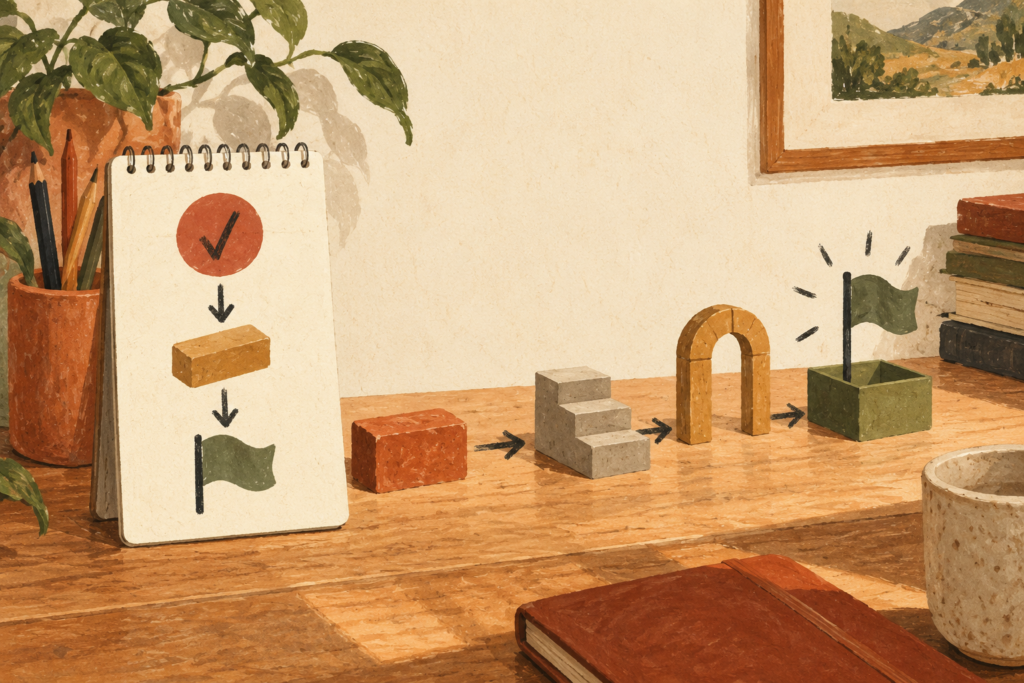
Insurance has been on your list for five weeks. It is not a difficult job, and you have not decided against doing it. Each morning your eye lands on the word, you feel a faint reluctance, and you move on to the next line. By now you have probably concluded that this says something unflattering about your discipline.
More often it says something about the sentence. Most items that stall were written in a way that makes starting them depend on a decision nobody has made yet, and that decision, far more than the work, is what you keep stepping around.
Why a task written as a topic keeps getting skipped
A task written as a topic keeps getting skipped because a topic cannot be started, only thought about. Look at what stalled items usually have in common: website, insurance, Dad’s birthday, Q3 planning. Each names an area of life and leaves the action unstated.
David Allen’s central point in Getting Things Done is that you cannot really act on an item until its next physical action has been identified. Until that happens, every encounter with the line asks you to do the thinking again from scratch. Thinking costs more than doing, so in the two seconds it takes to read the word, the item gets deferred once more.
That is the whole mechanism. The reluctance you feel has little to do with the work itself. It is the small cost of an unmade decision, charged each time your eye passes over the line, which explains how an item can sit untouched for weeks and then take eleven minutes once someone finally decides what it means.
Three questions every task should answer before it goes on the list
Before you write a task down, check it against three questions. An item that fails any one of them is likely to stall.
Does it start with a verb you could do with your hands?
Draft, call, send, print, ask and book all qualify. Sort out, deal with, look at and think about do not, because each one stands in for a decision you have not made while looking like an instruction.
Can you see the first move from the sentence alone?
Reading the line on its own should tell you what to physically do in the next sixty seconds. If you would first have to rebuild the context, put that context into the line: the person’s name, the file, the phone number. Ten extra words today saves the same reconstruction on twenty future readings.
Will you know when it is finished?
Work on the proposal has no end point, so it can never be crossed out, and the day finishes unresolved whatever you actually did. Draft the pricing section can be finished. Tidiness has nothing to do with it; what matters is whether the day is able to end with something complete.
Writing the task for a tired reader three weeks from now
The person who will read the task is a version of you three weeks from now, at eight in the morning, tired, with none of today’s context in mind, and it helps to write for them directly.
That person will not remember which of the two invoices you meant, or that the answer depended on hearing back from someone first, or that you had already ruled out the obvious approach. Whatever you are holding in your head today will have gone by then, and its absence is what makes an old line feel obscure and faintly unpleasant to read.
A useful standard is to ask whether a capable stranger could act on the sentence. Wherever they could not, add the missing piece: the name, the number, the file, or the decision you already made and would otherwise have to make again. Context is cheap to write down once and expensive to rebuild over and over. This is unglamorous work, and it accounts for much of the difference between a list that moves and a list that gets rearranged instead, which is the displacement activity a badly written list so reliably invites.
Adding a when and where to tasks that keep slipping
If a task is clearly written and still keeps slipping, add the moment and place you will do it.
Peter Gollwitzer’s research on implementation intentions found that deciding when, where and how you will act leads to better follow-through than holding the goal in general terms. The shape is a simple if-then: when I sit down after lunch, I will draft the pricing section.
For a task, that changes what it depends on. Without a moment attached, the line relies on you remembering it at a suitable time; with one attached, a situation that will happen anyway does the reminding. When an item has survived three weeks on the list despite being well written, giving it a moment is often what finally moves it.
Why a well-written task also quietens the evening
A clearly written task settles your mind as well as guiding your morning, and it does so whether or not you look at the list again that day.
Masicampo and Baumeister found that unfinished goals intruded on people’s thoughts during unrelated tasks, and that making a specific plan for them removed the interference before any of the work was done. The word that matters for task-writing is specific. A vague note such as insurance settles nothing, because nothing has been decided, so the item keeps surfacing at eleven at night.
A line with a verb and a first move registers as handled, even though the work is still to come. That is why the quality of your task-writing affects your evenings as well as your mornings, and part of why an unfinished list feels heavier than the work it describes.
Why careful tasks only work if there are few of them
Writing tasks this carefully is only sustainable when there are very few of them, so the last step is to write far fewer.
A list of forty well-specified items still asks you to compare forty things, and it will still blur into one undifferentiated sense of pressure. Careful writing pays off most when it is spent on one item a day, the one that genuinely matters, while everything else is held loosely somewhere it does not have to compete for attention.
One sentence, written the night before, with a verb and a first move, is a small enough thing to get right every time. It is also the only one that has to survive a difficult morning.
The Do One Thing diary is built around that limit: a printed page with room for a single line a day and nothing else. Having only one line is what pushes the sentence to be good, since there is no room to be approximate and no second item to hide behind.
Most stalled work says very little about your character. Usually a topic is sitting where an instruction should be, and putting that right takes about eight seconds an item.