Why Your Brain Builds Habits Behind Your Back (and How to Use It)
Think about the last time you drove somewhere familiar and arrived with no memory of the trip. You stopped at the lights. You signalled the turns. You made dozens of small decisions,…

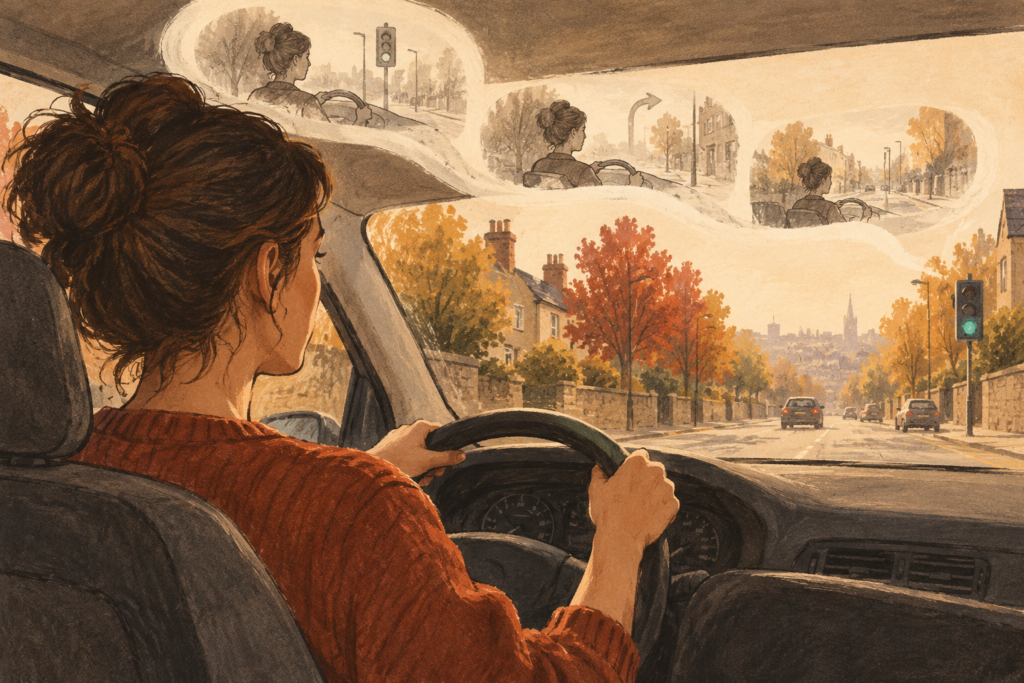
Think back to the last time you drove somewhere familiar and arrived with no memory of the journey. You stopped at the lights and signalled at each turn, making dozens of small decisions along the way, and none of them reached the part of your mind that narrates your day. Something did the driving competently enough, and it was not quite the self you would recognise.
That gap between what we do and what we notice ourselves doing is where habits live, and research over the last two decades suggests it accounts for a great deal of ordinary life. The psychologist Wendy Wood, in her book Good Habits, Bad Habits, reports that roughly 43 percent of what people do on a given day is repeated in the same context, usually while their attention is somewhere else. A large share of daily behaviour, in other words, gets replayed more often than it gets chosen.
Knowing how that replaying is built is more useful than any amount of motivation, because it shows which levers actually move a habit and which ones only look as if they should.
How the cue, routine and reward loop builds a habit
A habit forms when a cue, a routine and a reward are repeated together often enough that the cue alone starts to set off the routine. That is the model Charles Duhigg made popular in The Power of Habit. The cue is a trigger that tells the brain to switch into automatic mode, the routine is the behaviour itself, and the reward tells the brain that this particular loop is worth remembering. Run it enough times and the routine follows the cue with very little consultation.
Duhigg’s favourite illustration comes from the history of advertising. In the early twentieth century, the adman Claude Hopkins took an obscure toothpaste called Pepsodent and helped turn brushing into a national habit. He did it by pairing a clear cue, the film a tongue can feel on unbrushed teeth, with a clear reward, the cool tingle of mint and the feeling of a clean mouth. In dental terms the tingle was almost beside the point, yet it gave the brain something to look forward to, and the loop closed around it.
What makes the loop worth understanding is a lopsidedness in how it works over time. The reward is what builds a habit, but once the habit is established, the cue does most of the work and the reward matters much less. That is why people go on doing things that stopped satisfying them long ago.
What happens in the brain as a habit takes hold
As a habit takes hold, the brain compresses the whole sequence into a single chunk and marks only its beginning and end. This has been observed directly, neuron by neuron, in the lab of Ann Graybiel at MIT, one of the leading researchers on the basal ganglia, the deep brain structures involved in automatic behaviour.
Graybiel’s team taught rats to run a T-shaped maze for a reward, recording the firing of neurons in the striatum while the animals learned. Early on, when the task still took effort, the neurons were active throughout the run. As the route became a habit, the activity reorganised into a pattern the researchers called task-bracketing, with a burst at the start, near quiet through the middle, and another burst at the end. The middle of the run had, in effect, been left to look after itself.
That chunking is the physical signature of automatic behaviour, and it explains why an established habit feels so easy. The conscious mind has passed the routine to machinery that no longer needs anyone watching over it.
The most revealing experiment came when Graybiel’s group made the reward worthless to the rats, so that the animals no longer wanted it. A creature acting purely towards a goal should have stopped. The habitual rats kept running the maze anyway, because the behaviour had come loose from the reward that created it and attached itself to the cue and the setting. The habit only stopped when the researchers used optogenetics to quiet a small region of the prefrontal cortex, the infralimbic cortex, and in some cases it stopped almost at once.
The practical meaning is sobering and freeing in roughly equal measure. Once a habit is built, ongoing motivation has little to do with holding it in place, and structure does most of that work. So you cannot simply want your way out of a bad one, and you do not have to keep wanting your way into a good one either.
Why willpower does so little to change a habit
Willpower does little to change a habit, because the people who seem to have the most self-control are mostly meeting less temptation, as opposed to resisting more of it. That is one of the central points in Wendy Wood’s work. Over years of studies, she found that people with apparently strong self-control had arranged their lives so the behaviour they wanted was the easy path and the behaviour they did not want came with some friction attached.
Her three ingredients for a lasting habit are unglamorous: a stable context, enough repetition, and a reward early on while the loop is still forming. Inspiration does not appear on that list, and neither does identity. What decides the matter is whether the cue stays in place long enough for the brain to wire the routine to it. This is why moving house or changing jobs so often breaks old habits and lets new ones form, since the context that anchored them has gone.
It also explains why so many attempts at self-improvement fade. Effort goes into the routine, the visible middle of the loop, while the cue and the context that actually govern it are left alone. Trying to be more disciplined is the natural response, when making the wanted action obvious and the unwanted one inconvenient would do far more.
How to design the cue for a habit you want
To design the cue for a habit you want, make the right trigger impossible to miss and put it where it will meet you every day. Lay out the running shoes the night before. Leave the book on the pillow and the phone in another room. Attach the new behaviour to one that already runs automatically, so that an established cue does two jobs at once. None of these steps asks for willpower, and together they amount to designing the situation instead of fighting it.
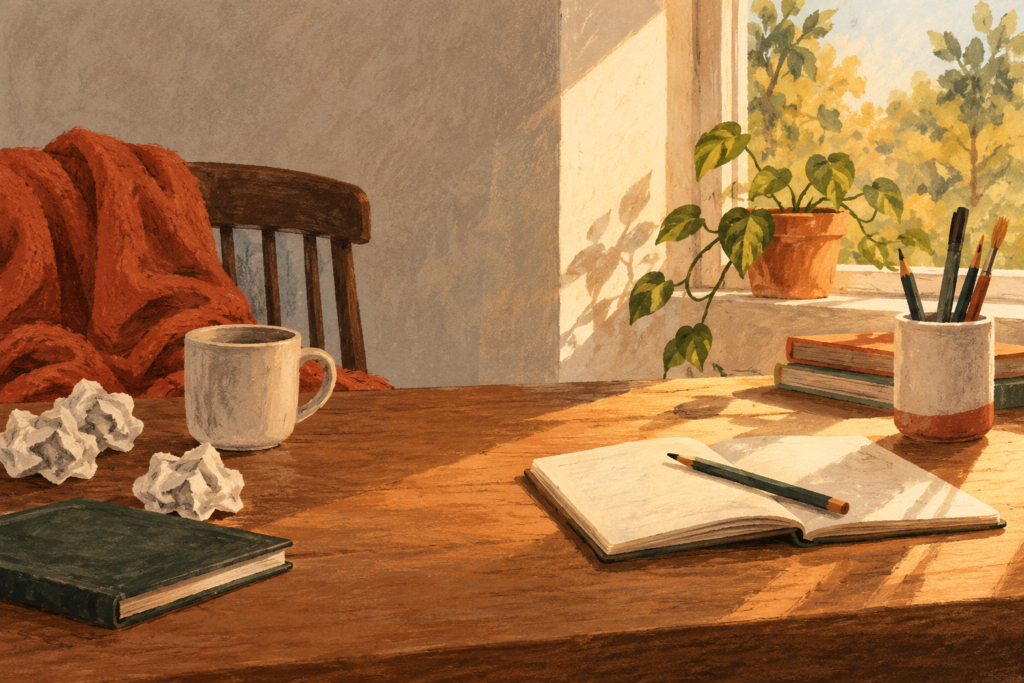
There is a deeper reason to keep that cue singular. A long list of intentions gives the brain no clear trigger, so nothing gets chunked and nothing becomes automatic. One repeated action in one stable context is exactly the condition under which the striatum builds its bracket. That is the logic behind choosing a single thing each day and writing it where the morning will find it without any searching. A paper diary you return to in the same place each morning works, in this sense, as a cue you have planted deliberately, more than as a planner.
The research does not promise that change will be easy. What it offers is more useful: change turns out to be a matter of structure, and structure is something you can build on purpose. You do not have to force yourself into becoming a different person. You need to give the person you already are a clearer signal, repeated in the same place, for long enough that the deeper machinery can take over.
The habit you want is waiting for a cue, and you get to decide where that cue goes.